History of the UT Bands
A Legacy of Sound, Spirit, and Tradition
For more than 150 years, bands at the University of Tennessee have helped shape the musical, cultural, and spirited identity of the university. What began in 1869 as a small military cadet band has grown into one of the nation’s most recognized and respected collegiate band programs.
Today, UT Bands encompasses nationally recognized concert ensembles, spirited athletic bands, and the world-renowned Pride of the Southland Marching Band. Across generations, the program has remained rooted in musical excellence, innovation, tradition, and a deep connection to the Volunteer spirit.
The Birth of the “Pride of the Southland”
The 1940s marked a transformational era for UT Bands.
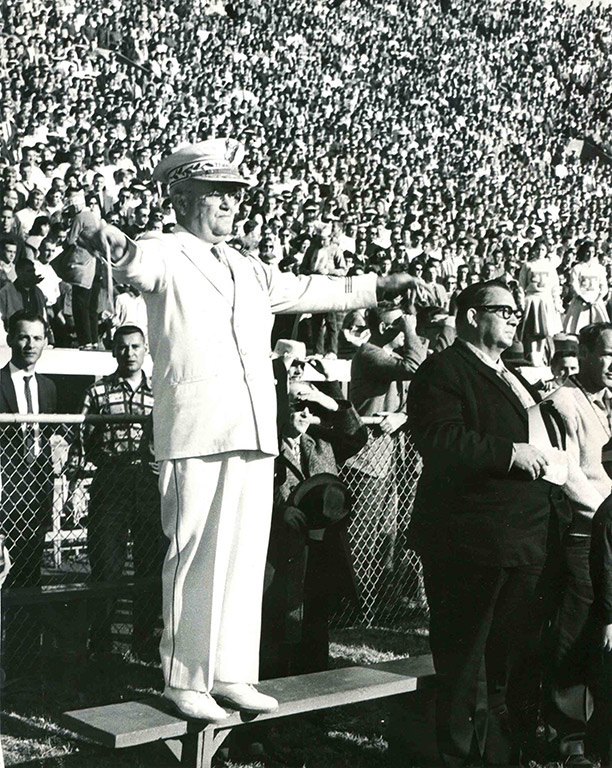
Under the direction of Walter Ryba, a former member of the John Philip Sousa Band, the marching band underwent significant artistic and organizational growth. Women musicians joined the ensemble, halftime performances became increasingly theatrical and theme-oriented, and the band expanded its role beyond military tradition into a modern collegiate marching ensemble.

Ryba’s influence helped elevate the band’s reputation throughout the region and beyond. During this period, Knoxville Journal sportswriter Ed Harris famously coined the nickname that would become synonymous with Tennessee tradition: the “Pride of the Southland.”
The title endures today as one of the most recognizable identities in collegiate marching band history.

Innovation, Tradition, and National Recognition
Following Ryba’s retirement in 1960, W.J. Julian ushered in a new era that would fundamentally shape the modern identity of UT Bands.
Under Julian’s leadership, the band transitioned from ROTC oversight into the academic environment of the College of Education, signaling a broader evolution in the role of bands at the university. Membership rapidly expanded, surpassing 140 members by 1964, while the ensemble developed a national reputation for precision, musical excellence, and innovation in marching design.
Julian became widely recognized for pioneering the “circle drill,” a visual marching style that helped distinguish Tennessee performances on a national stage.
Many of the traditions most closely associated with Tennessee football and the Pride of the Southland also emerged during this period. In 1972, the band introduced “Rocky Top” to Neyland Stadium, where it quickly became one of the university’s most beloved traditions. The now-iconic opening of the “T” for the football team also became a defining part of Tennessee pregame ceremonies under Julian’s leadership.
The influence of this era extended far beyond Knoxville, helping establish UT Bands as one of the premier collegiate band programs in the country.
Concert Bands and Artistic Excellence
While the Pride of the Southland became nationally associated with Tennessee spirit and tradition, the university’s concert bands simultaneously developed a reputation for artistic and educational excellence.
In 1962, Dr. W.J. Julian helped establish a full-year band program at the university, leading to the formation of the Wind Ensemble and expanded opportunities for concert performance and study. Over time, the program evolved into the UT Concert Bands structure known today, including the Wind Ensemble, Symphonic Band, and Concert Band.
These ensembles have performed at conferences and events hosted by organizations including the American Bandmasters Association, College Band Directors National Association, National Band Association, and Music Educators National Conference. UT concert ensembles have also appeared in major concert halls across the country, representing the university through performances rooted in artistry, collaboration, and musical innovation.
Today, the concert bands continue to serve as a cornerstone of the academic and performance experience for student musicians at the University of Tennessee.


Continuing the Legacy
UT Bands continues to evolve while remaining deeply connected to the traditions that have defined the program for generations.
In the decades following Dr. Julian’s tenure, leadership under directors including Dr. Gary Sousa, Dr. Donald Ryder, and Dr. John Zastoupil helped continue the program’s trajectory of excellence. The Pride of the Southland expanded its in-game experience, strengthened its national visibility, and continued to build upon longstanding Tennessee traditions.
Today, the program is led by Director of Bands Dr. John Zastoupil, alongside Director of Marching and Athletic Bands Dr. Michael Stewart and Associate Director of Marching and Athletic Bands Dr. Fuller Lyon.
From concert halls to Neyland Stadium, UT Bands remains a defining part of the University of Tennessee experience, connecting generations of students, alumni, and fans through music, tradition, and Volunteer spirit.